Tuesday, March 15, 2011

8 People & Trends To Watch

The Gadflies
Michael Shellenberger and Ted Nordhaus pissed off a lot of their green friends when they skewered the enviro movement for its failed 15-year crusade against global warming in their 2004 paper "The Death of Environmentalism." After lambasting enviros for becoming self-absorbed and irrelevant, the researchers are now pushing a Health Care for Hybrids bill that requires automakers that get financial bailouts to produce cleaner cars. Plus, they've taken on Robert F. Kennedy Jr., a high-profile environmentalist, in his fight against building a wind farm on Cape Cod - a battle that could sour investor interest in wind energy. "Developing wind power is more important than saving the Alaskan wilderness," Shellenberger says, "which is all going to end up underwater from global warming anyway."

The Evangelizer
Frustrated by the inability of scientists to sound the alarm on global warming, Laurie David, a talent booker-turned-activist married to comedian Larry David, sought out the moral authorities of our time - funnymen Jack Black, Tom Hanks, and Steve Martin. It worked. Dolled up, dumbed down, and democratized, climate change has been rebranded from a fringe issue for wonky worrywarts to an A-list fret. In 2005, David began a campaign to embed the topic into everything from Alias and The Bold and the Beautiful to the National Council of Churches. Her latest win: conceiving and producing the documentary An Inconvenient Truth, starring Al Gore. "It's the march of the penguins!" David says of her push to give the eco movement mass-market appeal. "I want everyone marching!"

The Diesel Governor
Montana's coal fields hold the equivalent of 240 billion barrels of clean diesel, which almost makes the state another Saudi Arabia. Governor Brian Schweitzer has been hustling GE, Shell, South African Sasol, and the US military to invest in converting that coal into diesel; with oil at more than $40 a barrel (the price at which coal-to-diesel conversion becomes cost-efficient), they're interested. Schweitzer also wants to jump-start a US biofuels industry by adding farm subsidies to alt-energy-producing crops like soybean, safflower, camelina, and canola. Schweitzer, a Democrat, picked up his agricultural self-reliance in Saudi Arabia, where he helped design the irrigation system that turned the kingdom from a wheat importer into a net exporter of wheat in the '80s. The US, he says, can do the same for fuel.

The Builder
"People who aren't building green buildings are building obsolete buildings," says Douglas Durst, whose reign as copresident of the Durst Organization, his family's 90-year-old Manhattan real estate firm, has been as successful as it is idealistic. He's turned high-rises into eco-towers ventilated by outside air, insulated with high-performance glass that cuts energy bills, and made of recycled materials (like steel and carpeting). Even the US Green Building Council, a standards body, is impressed: It certified Durst's 4 Times Square (home to Condé Nast, Wired's owner) the nation's first green office. His latest project? The Helena, a tower with on-premises black-water treatment and a solar-paneled rooftop garden. With another apartment and a BofA tower in the works, Durst is turning New York green.

Pollution Trading
In 2003, after the US bailed on the Kyoto Protocol, the Chicago Climate Exchange began trading permission to pollute. Companies like Bayer, DuPont, Ford, IBM, and Motorola signed on, eager to position themselves ahead of any government carbon regs to come. Under the program, they agree to reduce their carbon emissions 4 percent by 2007 (or, for newer members, 6 percent by 2010). Hit their target early and they can sell their credits for roughly $2 each (one credit equals 1 metric ton of CO2). CCX, which has 140 members, includes cities like Chicago and Portland, Oregon, and multinationals facing mandatory reductions in Europe. Founder Richard Sandor, who pioneered the financial futures market on the Chicago Board of Trade, says carbon emissions could outpace oil to become the most heavily traded commodity.

Nuclear Power
Solar. Wind. Hydro. As replacements for fossil fuels, they're not enough. So countries are increasingly turning to nuclear energy for the clean power that the global economy demands, and now, 20 years after Chernobyl, there's a resurgence of nuclear plants. More than 400 reactors in 31 countries (104 in the US alone) provide 16 percent of the world's electricity. China expects to add 32 more facilities by 2020. Nuclear is cheaper than other energies, it doesn't need to be imported, and it doesn't come with emission taxes. Nonetheless, it remains controversial for all the obvious reasons: disposal of spent fuel rods, vulnerability to meltdown or arms proliferation - but even the US, which hasn't seen a new nuclear plant in a decade, is getting ready to build reactors in Mississippi and Alabama.

Green Machines
The Prius is just the beginning. This year, Toyota will roll out a hybrid version of the Camry, the top-selling car in the US. The next phase of green car tech follows fast: The Mercedes F 600 Hygenius pairs a lithium-ion battery with fuel cells to run nearly 250 miles on a tank of hydrogen. Meantime, about 40 percent of cars in Europe are now biodiesel-ready. Adoption of the fuel in the US, where it lags, may soon get a boost thanks to new additives and blends that reduce the nitrogen oxide emissions and keep biodiesel from jelling in cold weather. Other innovations in the works include BMW's Turbosteamer motor, which harnesses heat from its exhaust and cooling system to power the engine, and Mitsubishi's plant-based plastics used throughout its autos.

Power Plants
Coming soon to US cornfields: ethanol plants. There are now 95 facilities in operation, 34 under construction, and more on the way. The goal: to more than double production of the corn-based fuel to nearly 10 billion gallons by 2015. (Still, that's just a fraction of the 140 billion gallons of gasoline Americans guzzle each year.) Among those turning maize into gold is Jefferson Grain Processors, led by Paul Olsen, a third-generation Wisconsin farmer. His operation will produce 140 million gallons of ethanol, plus biodiesel, electricity, CO2, animal feed, and 8 million pounds of fish - farmed, processed, and fried - all using the excess energy from ethanol production. "It's a Wal-Mart society - you've got to be efficient," Olsen says. If prices fall? "It's ethanol. We can always make hooch."

Monday, March 14, 2011

8 Types of Headlines that Sell

For my upcoming book, N-of-8, I have been collecting a wide variety of “top 8” lists you can use for inspiration.  You might find seeds of ideas that can apply to a wide array of challenges.


Here is a list of 8 types of headlines that sell.

1. The News Headline: 
If your product or service offers something newsworthy, announce it in your headline. You would normally use this to introduce a new product or the improvement of an existing product. Here are some words you can use in your News Headlines: New, Announcing, Introducing, Finally, Just released, Now, At last.
Examples:
“At last! A Tooth Paste Kids Will Love”
“New Diet Burns Off More Fat Than If You Ran 98 Miles a Week”
“Announcing . . . The New Bald Cure Guaranteed To Make Even Trevor
Crook Look Like He’s Got A Full Crop Of Hair!”

2. The Guarantee Headline:
These state a desirable benefit and guarantee results or other benefits. If you offer a powerful guarantee . .. let your prospects know by stating it in the headline.
Examples:
“Makes Money In 90 days Or It’s FREE Under my 100%, Unconditional
Money Back Guarantee”
“Hands Which Feel As Smooth As Silk In 24 Hours . . . Or Double Your
Money Back!”

3. The How To Headline:
With over 7,000 book titles starting with ‘How To’ you can’t go wrong with this one. If you ever get stuck, try adding ‘how to’ in front of your headline as these type of headlines promise your prospect
a source of information, advice and solutions to their problems.
Example:
“How To Win Friends And Influence People”
“How To Avoid Snake-Oil Selling Scumbags On The Internet”

4. The Benefit Headline:
Benefits sell . . . features DO NOT! To write a successful benefit Headline, you must know your market so well,you can offer them a powerful, compelling benefit driven headline which they can’t easily get somewhere else. You must do your homework though in order to know what benefit will motivate your prospect/s to take action.
Examples:
“Dries Up Your Hay Fever In 15Minutes”
“Stops Diarrhea in 30 Minutes”
“It Cleans Your Breath While It Cleans Your Teeth”

5. The Question Headline:
Be careful when using this one. You must know your market backwards otherwise you can blow your whole advertising campaign. The best types of questions to ask are questions which get your prospect involved.
Examples:
“Do You Make These Mistakes In Marriage?”
“Do You Make These Mistakes In English?
“Can You Smash Through 6 Bricks Like Dr. Stan ‘Breakthrough’
Harris?

6. The Reason Why Headline:
These give your prospect specific reasons why they should read your ad, sales letter or website. These are very effective because they contain facts and specific numbers.
Examples:
“27 Reasons Why You Should Attend Trevor Crook’s Persuasive Writing
Sells Online Course”
“37 Fun And Easy Ways To Earn$500 In Your Sleep”

7. The Testimonial Headline:
This is just what it says. It uses a customer testimonial for a headline. This gets your customers to sell for you by talking about the benefits they received.
Examples:
“How I Make $557.63 Per Week In My Sleep”
“I Had Never Purchased A Share In My Life. I Opened A Share Account
With $14,000.00 After Attending The TradingEdge Workshop . . . In Six
Months My Account is OVER $21,000!”

8. The Command Headline:
This tells your customers what to do. Your command should encourage action by offering your prospect a benefitwhich will help them. The most effective command headlines start out with action verbs.
Examples:
“Stop Baldness Today Before Your Head Looks Like A Bowling Ball”
“Stop Wasting Time On Advertising Guesswork”
“Stop Being An Advertising Victim”

If you also have lists, quotes, or articles, I invite you to share themin the comment section below.

Innovation that come from the words and thoughts of others often come through a new route in the imagination:  free association.  This can lead you to explore links that would not be ordinarily brought to bear.  It increases your probability of looking at the challenge in a new way.

Thursday, March 10, 2011

8 kinds of creativity

One way I’ve found to gain innovative insights is called “forced connection.”  When you give concentrated attention to seemingly random information or visual, you can allow your brain to process it and find a new relationship or meaning. This leads to original ideas and original ways to implement them.

So for my upcoming book, I have been collecting a wide variety of “top 8” lists you can use for inspiration in your N-of-8 exercises.  They contain seeds and sources of ideas that can applied to an array of challenges.  And when you find one seed you might find an entire garden – or even a farm – of new insights.

Here is a list of 8 kinds of creativity from The Creativity Conundrum: A Propulsion Model of Kinds of Creative Contributions by Robert J. Sternberg.
  1. Replication
  2. Redefinition
  3. Forward incrementation 
  4. Advance Forward Incrementation
  5. Redirection
  6. Reconstruction/Redirection
  7. Reinitiation
  8. Integration
Consider collecting your own lists, quotes, and articles. From books, magazines, biographies, the Bible (or other religious texts), newspapers, trade journals, best-selling songs, and many more sources.

Innovation that come from the words and thoughts of others often come through a new route in the imagination:  free association. This can lead you to explore links that would not be ordinarily brought to bear. It increases your probability of looking at the challenge in a new way.

Tuesday, March 08, 2011

N-of-8: a view from a creative group perspective

The lessons of effective innovation transcend brand category, market sector, business model, media, and even regulation.

My firm has worked with creative groups from more than three-dozen companies in health, science, and technology.  I have written, supervised, and conducted hundreds of surveys, teleconferences, and focus groups for nearly every kind of pharmaceutical, device, instrument, and service imaginable.  At last count, I had worked on more than 50 new product launches in my career.  And our consultancy has created and/or advanced more than 150 brands since 2003.

And now my upcoming book, N-of-8, takes on a creative storytelling process.

I’ve outlined the principles in a logical flow of situation-problem-solution-application.  Then, I offer a series of examples that might best illustrate those principles. This has meant reconstructing case studies from both my personal and my company’s memory.  Finally, I’ve attempted to document the N-of-8 processes in a meaningful and useful way.

All the while, I reflect on the successes, failures, and learnings from the experience with the N-of-8  tool.  I've learned from brands ranging from Fortune 100 pharma corporations to start-up biotech companies.  They represent N-of-8 projects conducted in some 23 countries.  And I have insights gained from in-depth interviews with clients, colleagues, moderators, participants, and sponsors of many of these projects.

In addition, my book references dozens of books and articles on group dynamics, storytelling, creative process, and idea facilitation – including how movies, music, and theater can teach us about developing and executing ideas in business.

N-of-8 is a creative brand innovation model that uses the science of "breakout" idea facilitation.  By definition, it represents:
  • An ideal group size -- 8 -- with participants who respect each other’s expertise
  • An optimum timeframe to create productive group interaction
  • A set of proven facilitation tools and technologies to accelerate ideas and capture action steps
In their book The Breakout Principle, William Proctor and Dr. Herbert Benson support this model and this group size.  They write,  “More than a numbers game. Each participant recognizes that the others have been chosen not because everyone is the same or naturally compatible, but for the opposite reason -- i.e., because as many participants as possible are quite different from one another and may even be prone to intense disagreements."

Monday, March 07, 2011

Instead of simply entertaining big ideas, empower groups to execute vision

A few years ago in Toronto, I was shocked by a seminar speaker who opened his keynote address by telling us, “Don’t believe a word I say.”  Why would he say that?  Because he was only speaking from his own experience.  And I say the same thing to you as you read my books, blogs, white papers, or other publications.  None of the concepts and insights I share are inherently true or false, right or wrong.  They simply reflect my own results, and the results I’ve seen in the dozens – even hundreds – of N-of-8 participants I’ve worked with.

Having said that, however, I do believe that if you use the principles, you will achieve true innovation.  Don’t just read the book.  Study it. Mark it up. Then try the exercises for yourself.  Whatever works, keep doing. Whatever doesn’t, you’re welcome to modify it.

I am no doubt biased when I say this, but when it comes to brand innovation, this tool has provided a missing link between my desire for change and my achievement of it.

No matter what market you’re in, your future success is being shaped by innovation occurring today.  Remember a time when you asked yourself, where did all those Starbucks come from?  And what happened to all the video stores?  And why do both Best Buy and Radio Shack exist? Same with Costco and 7-11.  Can you recall the first iPod you saw (or laptop computer, or Walkman, or mobile phone)?  Who thought these things up?  More important, how did the creative groups bring them to market.

N-of-8 principles can train you how.

It is specific, practical, linear, and intuitive – yet stretches your imagination.

You have to decide for yourself why you want a model for new ideas.  Here are a few goals clients have shared with me:
  1. Find new avenues to make money.
  2. Expand into new business opportunities.
  3. Modify existing ideas to create a more innovative and powerful idea.
  4. Design new products, services, and processes.
  5. Improve old products, services, and processes.
  6. Develop solutions to complex business problems.
  7. Revitalize stagnant markets.
  8. Learn to view problems as opportunities.
  9. Become more productive.
  10. Be the “idea person” in your organization.
  11. Know where to look for the “breakthrough idea.”
  12. Generate ideas at will.
  13. Become indispensable to your organization.
In my book, I will shed light on why some people, some teams, and some companies are moving beyond “creativity” and accomplishing such innovative results.

It’s because they have challenged their old approaches and have learned that these methods were in fact obstacles to innovation.  They have chosen not to simply entertain big ideas, but actually empower groups that can execute their vision.

Thursday, March 03, 2011

N-of-8 Advisory Boards -- producing actionable results

Life science industry marketing executives rely on key opinion leaders (KOLs) — physicians and other stakeholders who have earned credibility with their medical colleagues based on their expertise and scientific stature — to diffuse innovation and disseminate scientific information regarding innovative treatments and new products. Thought leaders are a critical component of a bio-pharma company’s professional marketing and medical strategies.  But companies face a real challenge in creating, maintaining, and leveraging those relationships while safely navigating logistical issues and regulatory waters.

One enduring problem is in finding an appropriate way to measure the impact of interactions between brand innovators and KOLs. In part, this is a matter of regulation: Because advisory boards shouldn’t be treated as sales occasions, it is risky to assess them the way you’d assess a focus group—by number of positive reactions.

But even without regulation, that sort of metric would seriously misrepresent the nature of the relationship between a product development group and KOLs—a relationship that is based on science, mutual collaboration, and engagement, and tends to evolve over longer periods of time than interactions with inline marketers.

The thought leader interaction is a process; as such, it may not yield the same kind of immediate, measurable results seen on the commercial side of the company.

In my upcoming book, I will apply the principles of N-of-8 to the ubiquitous tactic of “advisory boards.”  That means we will review how the tool can be use in identifying the right advisors, maintaining a practice focus, creating an agenda, and producing actionable results.  I’ll also share some very functional guidance on the reporting of the N-of-8 sessions.

Tuesday, March 01, 2011

8 communication traps that foil brand innovation

Most leaders are interested in growing their businesses through innovation, but it's risky business: most innovation efforts fail.

After years of helping to make innovation happen as chief communications officer at Steelcase and as a consultant, Georgia Everse has a point of view that she’s willing to bet on:  Innovative ideas, initiatives, products, culture transformations, you name it, have little chance to succeed if they aren't enabled by smart communications.

In a recent article on the Harvard Business Review website, she says this includes communication within the core team, broadly in your organization, and with key stakeholders outside the organization, including your distribution channel partners, suppliers, journalists, investors and of course, existing and potential customers.

Ms. Everse is a communications and marketing executive with 30 years of experience and a proven track record of finding innovative solutions to complex business problems. She specializes in helping C-level executives find and articulate their vision and successfully use strategic communication to achieve their growth goals. Georgia is a visiting professor for the Ferris State University MBA program, in Design and Innovation Management. She is currently a partner with Genesis Inc., a brand, strategy and communications consultancy.

Here are the 8 traps she says to avoid as you innovate.
  1. Don't break ground in the wrong direction. If your organization hasn't explicitly communicated your core reason for being, you'll need to start here.
  2. Don't lose sight of the horizon. The complexity and uncertainty of forging new ground makes it easy to get lost.
  3. Don't make the process a mystery. Successful initiatives are supported by a well-defined process, which should become the foundation for successful internal communication.
  4. Don't under-communicate. For it to be successfully implemented, your development project needs to be accepted into the operations side of the business.
  5. Don't let cynicism undermine the process. Taking your company into new territory of any kind never comes without some healthy skepticism from your positive team players and cynicism from your naysayers.
  6. Don't let key insights hide in a binder. The best ideas are born out of a discovery process that unveils insights into the behavior patterns of people.
  7. Don't let jargon hide the truth. In most organizations different functional groups use their own languages. Recognize the power of words in getting the development team aligned and achieving the positive results you hope for.
  8. If it's off-brand, don't do it. There should be a strong connection between your growth initiatives and your brand strategy. The two should inform and sustain each other.
Click here to read the full article.

Monday, February 28, 2011

19th century innovation classic: Medical Essays by Oliver Wendell Holmes, Sr.

"It is the province of knowledge to speak and it is the privilege of wisdom to listen."
-- Oliver Wendell Holmes, Sr., medical reformer and poet

Click here to download your free e-book edition of Medical Essays.

Thursday, February 24, 2011

N-of-8 most integrated IHNs

SDI has released its 2011 Top 100 IHNs, a yearly assessment of the most integrated healthcare networks. The SDI report, regarded as the nation’s premier rating system, evaluates IHNs on their performance and degree of integration.

Sentara Healthcare (Norfolk, VA) finished No. 1 for the second year in a row, with a score of 93.17 out of a possible 100.  That is two points higher than last year. Sentara is the only IHN to rank in the top 10 of the SDI IHN 100 for all 14 years of the survey.

The chart shows the others in the top 8.


The ratings are based on SDI’s IHN Rating System, which evaluates each network’s ability to operate as a unified organization in eight categories: integration, integrated technology, contractual capabilities, outpatient utilization, financial stability, services and access, hospital utilization, and physicians.

Tuesday, February 22, 2011

What are you listening for?

“Of all the leadership skills, listening is the most valuable but probably the least understood,” says Suzanne Ross of the Aerie Company.  “Those who listen only sometimes remain ordinary leaders. The exceptional ones are those who never stop listening. They learn before others about unseen problems and opportunities and that helps them become true market leaders.”

I appreciate Suzanne’s ability to integrate new thoughts and make the strategy + communications + leadership link to elevate performance.

Recently, Suzanne’s newsletter featured an article on Health Literacy, and I asked her if I could share it with my friends, too.
----------
By listening, we help ourselves and our clients stay open to new ideas, often hear what isn’t being said and find ways to solve problems and capitalize on opportunities. Yet like any skill, it takes practice. Last month as we encouraged our network to refine their skills as part of the National Day of Listening, sponsored by oral history project, StoryCorps, we were struck by the feedback our readers had as they shared what they’d learned by being better listeners.

So as we wrap up 2010, there is no better time to consider accomplishments and commit to use those lessons learned to help clients and colleagues continue to demonstrate their value and expand their market presence and leadership.

Here are some of our key insights from this past year.
  1. Have a clear purpose – Everyone has a story that reveals their value, but often companies and individuals struggle with how to weave it together. Simply stated, your purpose is solving a customer problem. Because you’ve been listening, you have a unique understanding of the problem and can show your value in how and why you solve it better than others. Changing the face of chronic disease with medical technologies may seem a grand purpose, but that’s exactly what Medtronic does. From communication with customers to strategic alliances to marketing campaigns to employee communication, it’s clear that the patient is at the center of everything they do. In fact, at employee meetings, people who have been helped by Medtronic devices are featured in video vignettes and live appearances to reinforce help ensure everyone understands how their functions advance the company's purpose.
  2. Be patient – Business tycoon Donald Trump has always preached watch, listen and learn. He knows from experience that you can’t know it all yourself and anyone who thinks they do is destined for mediocrity. So while we are an impatient society, those with the measurable plan who continually listen to customers, colleagues and competitors will be the companies and executives that move forward with better solutions, make quick mid-course corrections and respond more rapidly to opportunities. Consider the uncertainty that still remains around the healthcare reform act. Thankfully for employers, the health, wellness and aging services industries understand how the secret of patience is doing something else in the meanwhile and they have been actively working on more engaging solutions to support millions of new consumers who will have access to the system.
  3. Be persistent – Yes, you need to stay on the radar screen of your target audience, but remember that communication goes in two directions so you need to listen at least as much as you need to talk. Today life demands our participation so in this super connected world, companies and executives can ill afford to be introverts. Be open to how you keep the  lines open with all your various stakeholders from the ones who embrace technology and social media to those who need an integrated marketing campaign to reinforce your unique benefits to those who prefer face to face contact.
You’ve all heard the joke “how do you get to Carnegie Hall? Practice, practice, practice.” With a professional violinist and musician advocate sister, I know it takes more than patience and persistence. It requires a combination of talent, communication, focus and a damn good ear – parallel skills for market leaders. Few of us have realized the career visions we had as nine year olds like my sister, but what I know she and other leaders says is that it’s just as much about practicing as it is about listening. And yes, my sister has performed at Carnegie Hall. She’s got a return engagement with her Nashville Symphony in the next year and I’ll be one of her many fans listening closely for new ideas.

What’s your industry equivalent of getting heard at Carnegie Hall? If you need support to help identify, articulate and communicate your value in 2011 and beyond, The Aerie Company is listening. You can follow on Twitter @SuzanneJRoss

Monday, February 21, 2011

How does the urgency of overcoming obstacles to innovation apply to our work?

To be sure, decades of investment in pharmaceutical innovation have produced thousands of medicines that allow us to treat and prevent diseases better than ever before. Conditions that not so long ago were fatal can now be managed effectively and safely; epidemics that once devastated communities are becoming distant memories.

The positive impact of health, science, and technology innovation has been far-reaching. New medical treatments are helping people to lead healthier more productive lives, cutting costs in healthcare by replacing expensive medical procedures, and stimulating the economy with a healthier workforce.

Look at this list and recall the innovations we’ve seen – and picture the possibilities of advancements coming just over the horizon:


Taking all these factors into account, I believe that applying the N-of-8 tool can increase your brand innovation equity.

If the term “brand equity” refers to the awareness and preference that accrue to a product, then “brand innovation equity” might measure the impact of efforts to change customers’ behavior.

There could be many ways to measure this brand innovation equity, including some metrics that currently exist.
  1. Brand innovation as a financial asset. This may be subjective, but it would reflect the risk profile, market leadership, stability and global reach of the brand’s innovation initiatives.
  2. Brand innovation as a product differentiator. The classic product-level brand measurement example is to compare the price of a no-name product to an "equivalent" branded product. The difference in price, assuming all things equal, is due to the brand. The same kind of revenue premium approach could be applied to compare the before-and-after value of brand innovation application.
  3. Brand innovation as an image accelerator. Positioning studies map the mind of the customer to chart what associations with the brand that the consumer has. This approach measures awareness (recall and recognition) and image (the overall associations that the brand has). Similarly then, free association tests and projective techniques could be used to uncover the tangible and intangible attributes, attitudes, and intentions about brand innovation.  Brands with higher levels of behavior change would be higher in brand innovation equity.
When you consider N-of-8 to leverage all your company’s and brand’s values, you can see the possibilities in creating, launching, and communicating through more compelling innovation.  And beyond simply gaining market position, it can result in a more emotional connection between the brand and the customer.

The impact of brand innovation can be to execute an authentic and true-to-life strategy that can be applied uniquely and creatively in all avenues of interaction between the company, employees, and customers.

Successful brand innovation creates a memorable experience for the customer, encourages repeat business, and boosts the company's economic health. It is a long-term brand solution that can be leveraged by your team to showcase your brand's unique potential.

Thursday, February 17, 2011

Obstacle to Innovation #6: Void of expert leadership – “We can’t act on that until somebody big gives it the okay”

The road to a culture of greater innovation is a hazardous one.  This is because so many attempts at creativity and fresh thinking can fail. . .spectacularly.  Instead of creating new brand ideas, it creates a wake of frustrated employees and the perception of wasted time and resources.

It’s in this light that we look for a leader.

Leaders must, particularly in innovation, must provide their teams (along with their outside suppliers, vendors, and consultants) the space to allow people to unleash their creative potential.

There is a great saying that you don’t need a title to be a leader.  You can find expert leadership in some very unexpected places.

Take the case of Joan Samuelson. Ms. Samuelson was diagnosed with Parkinson's in 1987 and left the practice of law to found the Parkinson's Action Network in 1991.

She was co-chair of a regenerative medicine conference when she said:

“I think if we are committed to a plan that truly is going to achieve our vision – getting effective therapies and cures within a reasonable amount of time – and the public believes that there is a huge amount of time and talent and energy that people in the legislature, in the patient communities, in simply the voting public will be willing to invest...then they will see the vision [and support] a plan to achieve it.”

She was the right leader at the right time because the right people got the message.  PAN is credited with many successes in increasing federal research spending, including the 1997 Morris K. Udall Parkinson’s Research Act. Samuelson played an active role in the campaign resulting in the 2004 passage of California’s Proposition 71 Stem Cell Research and Cures Act. Since then, Ms. Samuelson has been appointed to a variety of advisory panels on biomedical research and health policy.

Tuesday, February 15, 2011

8 recent market trends – are they the “new market reality”?

Over the years, I’ve been involved with clients on many aspects of licensing, funding, and other aspects of commercializing new health science and technology. We learn from every new encounter with these deals. And we enjoy connecting with other business consultants who bring a unique perspective to the planning.

One such collaborator is Technology Commercialization Group (TCG).  TCG works with senior executives worldwide to help them launch and develop markets and business operations in the medical device, pharmaceutical, biotechnology, veterinary and related healthcare industries.

TCG recently shared this article with us.
---------
As we seek to create measurable value for the companies we work with, we take this opportunity to focus on the trends that will affect you and your business in 2011- 2012.  As we do that, one overall theme we are compelled to note is an even sharper focus on de-risking the business enterprise. In fact, one could argue that this attitude represents a shift in thinking that will persevere for some time to come, given the uncertainty that remains in the global economy, and with health care and regulatory reforms.

In today’s changing global medical market, the key questions have become “what’s the opportunity?” and “How can we reduce our risk as we increase the value of our assets and grow our revenues and profits?”

As opposed to the past decade, when companies in our industry literally expected that customers would adopt virtually all new products, if enough money was thrown into marketing, the reality now is very different.   For proof, we only need to look at the data:
  1. Currency fluctuations for the dollar and Euro are affecting the debt status of nations.  As a result medical companies view multiple revenue sources from international markets as a proven way of de-risking the business.  Even small to medium size companies in Europe are looking to US revenue sources, and vice versa.
  2. Good economic policies implemented by the more stable European countries are driving expansion into overseas markets. As an example, Germany’s medtech exports grew by 5.5% last year and now represent 40% of total turnover.  To de-risk their business, German manufacturers are developing US markets by picking and choosing selected customers and markets that generate attractive profits in the fastest way possible. 
  3. Government budget reductions in Europe and the US are favoring cost effective innovation and new products that offset medical care costs. Before product development is complete, smart companies know which innovations will help them meet these goals, and then complete the product, marketing, and financing plans. 
  4. To increase flexibility and operations efficiency, medical firms are down-sizing and out-sourcing manufacturing, R&D, and sales forces.  In this environment, companies are doing more partnering deals and acquisitions of advanced and more proven products. 
  5. Emerging firms, including US startup subsidiaries of established European companies, have increasingly moved to the virtual model to be more flexible and less capital intensive while launching products. While technical expertise is still a core competency, these virtual teams often include customer focused market and product development experts charged with ensuring the products will meet the market’s true needs before major marketing dollars are committed. 
  6. Venture capital remains scarce and the firms still investing are interested primarily in reducing risk, while the number of IPO’s remains relatively low as well.  This means that investors will be primarily focused on exits via acquisition, but this option won’t exist unless the products or technologies are targeting a true, proven, customer need. 
  7. The EU Medical Device Directive is increasing global harmonization and reducing regulatory risk even though it will increase the cost of regulatory approval for certain products. US companies launching first in Europe will increase in number, but the more informed executives have learned that Europe is not a unified market because of different reimbursement schemes in each country.  They develop very specific, yet fully comprehensive European launch plans. 
  8. FDA changes in the 510K approval process, along with proposed user fees, are galvanizing increased interest in launching first in Europe.  This is also driving small to medium European medical companies to develop more thoughtful US market entry plans and commercial strategies. No longer do they view signing up with a distributor as some sort of guarantee of success.
The bottom line is that companies of all sizes are learning how to de-risk their business because of the world’s economic conditions and because customers, patients, regulatory agencies and payors are demanding it.

Companies can’t assume that just because they have regulatory approval, and money for marketing, or have signed up a distributor in a new market they will be successful.  Innovative companies have found that it is possible to increase both focus and flexibility -- two key risk reducers -- by leveraging outside experts to help commercialize their truly innovative products with proven cost effective marketing and sales plans.

Monday, February 14, 2011

Celebrate Valentine's Day with free "Chocolate" ebook

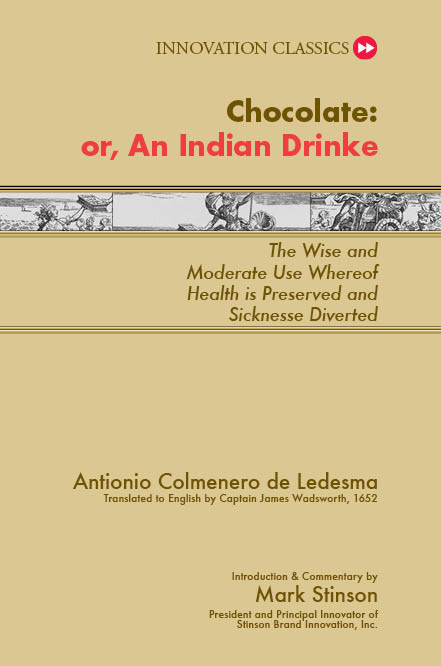
Here's my Valentine's Day gift to you -- a free e-book edition of the classic 17th century book Chocolate: or, An Indian Drinke by author and physician Antonio Colmenero de Ledesma.

From Valentine's Day to Halloween through to Christmas, chocolate is always there to celebrate a holiday. Back in the 1630s, Ledesma explained chocolate's role in health and wellness, as well as its history, culture and sensory pleasures. While we know now that overindulging leads to calorie concerns, the right amounts of the right kinds of chocolate can actually make one feel and even look better. Further, clinical research shows that eating chocolate and natural cocoa may improve vascular health, blood pressure, cognitive health, blood flow and skin health.

In this book, you will come to appreciate chocolate well beyond the health and nutrition aspects. You will understand the early fascination with chocolate that is now such a part of people's lifestyles, holding a special place in holidays and celebrations.

Giving the gift of chocolate has been associated with Valentine's Day for generations. During Valentine's week, consumers will buy more than 58 million pounds of chocolate candy, which equates to approximately $345 million in sales, according to Nielsen data.

This e-book is one in a series entitled Innovation Classics dedicated to collecting and publishing the best – or perhaps the underappreciated – innovation writing of the past.

Click here to download my Chocolate gift to you.

Thursday, February 10, 2011

Obstacle to Innovation #5: Lack of a back-up plan – “If we do that and it doesn’t work, then what?”

A main reason people are skeptical toward innovation is insecurity.  “How is this going to affect me PERSONALLY?” is really the question. Perhaps this is a normal reaction, based on a personal experience with innovation turning bad.  I am not sure of the cause, but let me tell you, if you are insecure, you’ll have rough time with innovation.

I have worked with many people who fought against “that new idea that will make miracles” but who took their share of credit when it was implemented and proved successful.

For brand innovation leaders to overcome this obstacle, start by explaining the entire project plan.  Be patient, as it may require time for people to understand.  Stay open to refining the innovation considering team feedback.  And instill confidence, by reassuring people that they can indeed manage to deploy innovation faster and they build an innovation track record.

Particularly with N-of-8 methods, you can create a set of contigency plans as you proceed through the innovation process. That way your team can face the insecurity knowing there are alternatives.

Tuesday, February 08, 2011

Obstacle to Innovation #4 Personal conflicts – “We aren’t going to do that just because she wants to”

The factions of personalities have never been more pervasive than today. In fact, these ideological clashes have become part of our cultural texture, from politics to talk shows, and from sports stadiums to boardrooms.

Often companies try to overcome the innovation obstacle of conflict with two approaches:
  • Bringing in a iconic leader
  • Promoting a symbolic declaration
Unfortunately, neither may do anything to address the underlying personal conflict.  Let’s look at the reasons why.

Iconic leadership in business and politics seems to be an attractive option these days. Superstar executives now occupy the corner suites of major banks, automakers, computer manufacturers, internet powerhouses, and even the White House and some Governor’s mansions.

When we want something great to happen, we look for the genius who has an idea. And this appeals to innovators themselves. Who wouldn’t want to be declared a genius -- with all that means in recognition, salary, advancement, and a dramatically heightened ego.

But what about the companies full of wanna-be stars running with their own ideas while ignoring or actively fighting the ideas of others.

Frankly, it is a myth to suggest that big ideas spring from one virtuoso. Innovation necessitates getting things done in a real world of dozens, if not hundreds of people, all aimed at bringing an idea to reality.

This without doubt means collaboration, which is the opposite of the conflict often created if the team thinks all the rewards and the glory will only go to the individual with the original idea.  They will refuse to improve on it, develop it, make it, package it, and bring it to market.

Symbolic declarations are another approach.

Once managers feel the urgency for brand innovation, they often turn to a fun tactic: internal communication. “Our people are not innovative,” they think, “because they haven’t really understood how important innovation is for our business.” This is when we’re asked to design a logo, a banner, a screensaver, or PowerPoint presentation saying “Innovate or die!”

The trouble is we’ve have heard it all before. So, employees at all levels are cynical because company leaders fail to follow through on their pronouncements. No one really “dies” or if the project fails, they blame the leaders. Teams understand that innovation is important, but their behavior won’t be expected to change until managers have changed behavior first (and not just your words).

Monday, February 07, 2011

Obstacle to Innovation #3: Information deficit – “We haven’t really done our homework on that”

How often have you seen two camps of people form during creative team meetings?

In one group are managers that demand a penchant for action. If in doubt, they say, fire first then aim.  They represent a whole cohort of managers who were raised, trained, mentored, and rewarded because they focus on action and execution above all else.

The other group claims to be more sensible.  They are the voices of reason.  They resist relying on trial and error. They must first take the time to answer a plethora of questions, consider a cornucopia of options, and gather a ream of data. In fact, this group criticizes the first group as people who “jump into action before they understand what the real problem is.”  To fact-checkers, the action group may be just concocting a solution – probably the first idea they came across – and executing it without even knowing if it actually addresses the underlying problem.

As you can guess, this conflict is happening in far too many health, science, and technology organizations.

The N-of-8 process helps address the needs of both groups.

Without the right preparation and planning, a brand team can waste an incredible amount of resources driving down the wrong path. Yet, you can lose valuable time and market position if you allow this obstacle to innovation to avoid the risk and responsibility of innovation.

Like a doctor who must diagnosis before prescribing, treating, or operating, an N-of-8 effort must first define the key questions – then move forward-fast to create the solutions.

Thursday, February 03, 2011

Obstacle to Innovation #2: Practical limitations – “We don’t have the time, staff, budget, etc. to do that”

This is especially true in our industry. Overworked people at health, science, and technology companies of all sizes often push back against suggestions of ideas they might take to improve their brand’s chances of success.

They protest, “I’d really like to do that and I know I should, but I don’t have time.” But what’s the real message? Let’s see what the refrain of “But I don’t have time!” might really mean.

Here are some comments you might hear from the R&D and Brand Managers.

“But I don’t have time to hold a retrospective,” declared the manager of a recently failed product launch when we suggested an N-of-8 to address what went wrong before they launched a follow-on campaign. You could realistically interpret this message as, “We must get started on the next project immediately because it will take us so long to recover from those previous mistakes.”

I know a very successful executive who built his entire career by studying the “lessons learned” repository when taking on a new position, then he charted a course based on the missteps of those who went before. A brand manager who doesn’t have time to peruse the lessons learned has opted instead to suffer with some of the same problems that previous managers have experienced – and risk the same failure.

You might have heard a manager say, “We don’t have time to write a project brief.” This person is relying on a mind meld to substitute for oral and written communication. The translation might be, “We need to start creative development immediately so we have time later to change it.” This never seemed efficient to me.

Now, what about objections you hear from Product and Brand Designers.

“I don’t have time to do a performance feasibility evaluation,” argued the harried industrial designer. What he meant was that he would find plenty of time to re-architect the design later when he couldn’t satisfy the performance requirements. I get nervous when I hear an art director say, “I don’t have time to do a bunch of design concepts. I need to get something out right away!” Amazingly, she’ll always have to make time to reverse-engineer the design and requirements when the clients require a change.

What shall we think when we hear a medical writer say, “But I don’t have time to put this through q.c. right now”? Does the writer believe that he’ll need the time he saves by skipping the proofreading to fix the errors that the editors will ultimately find in his copy? Odds are he’ll need many more hours for re-writing than if he had subjected his copy to the scrutiny of some colleagues before unleashing the clients’ reviewers on it.

And there are more objections you could hear from anyone on the Brand Team.

They may not think you have time to spend on creative process improvement, but everyone wants the benefits of improved innovation that can come from changing the ways we work.

In one seminar I spoke at recently, the audience complained that they were being asked to do more work with fewer people. When I asked what the organization was doing to enable this outcome, the reply was “Nothing.” There’s never a convenient time to take the actions that we believe will pay big dividends. But the inconvenience of later fixes generally comes back with a vengeance. All you’re doing is passing the inconvenience along to the customer, and then back to your organization when the complaints roll in.

To save time and money, you can beef up your creative development practices with N-of-8.  You will be investing in more thorough upfront research, you will be iterating faster on your product and brand designs, and you will be accelerating the review of your ideas.

In essence, you will be doing all those things that people erroneously argue take too much time.

And if someone debates the importance of these N-of-8 activities, you can respond, “But we don’t have time to cut corners.”

Tuesday, February 01, 2011

Obstacle to Innovation #1 Process & procedures – “This is the way it’s always been done”

When you say “we want to be innovative,” it’s like declaring “I want to be successful.” It may be a good beginning, but it doesn’t really help in deciding what to do.

Nevertheless, when we’ve talked with some senior managers in healthcare, they often express their visions in this kind of high-level dreaminess. Then, they tell their teams that they want more innovative ideas – “Think differently! Be the change! Go outside the box!”

But, in the end, we are unclear what this means. And finally, we drift back to the familiar and the tried-and-true.

Dr. Paddy Miller and his colleague Thomas Wedell-Wedellsborg at the IESE Business School in Barcelona, Spain have written about this obstacle.  They say, “Asking for innovation is not enough because ‘innovation’ is not just one thing. There is radical and incremental innovation. There is innovation in marketing, finance, product development, branding, process, services, experiences, and even in the way we lead our businesses. There is innovation aimed at becoming market leaders, and innovation aimed at just keeping up with the Joneses. There is innovation for the sake of improving efficiency, increasing satisfaction, reducing costs, retaining employees, attracting talent, becoming ecological or improving images. Innovation comes in so many guises, and can be pursued in so many ways, that it is easy to get lost if you don’t have a proper idea of where you want to go. For this reason, it is the first task of an Innovation Architect to craft an innovation strategy that dovetails with the company’s strategic playbook, and that is specific enough to help people make operational decisions about how to pursue innovation.”

So, processes and procedures must be addressed to overcome the obstacle.

Here’s an example from Chicago public schools.  Officials could not say how much the system spent on computers because of the chaotic state of – you guessed it – their computer accounting. Computer purchases were listed under various categories in different funds and labeled in different ways.  For example, computer giant IBM was listed five ways in the computer, as IBM, IBM Corp., IBM Corporation, International Business and International Business Machine.  Because it was the way it was always done, each entry was under a different vendor number.

Then, there’s another story that’s now become a legend on the need to challenge the conventional wisdom.

The US standard railroad gauge (distance between the rails) is 4 feet, 8.5 inches. That is an exceedingly odd number. Why was that gauge used? Because that is the way they built them in England, and English expatriates built the US railroads. Why did the English build them like that?  Because the same people who built the pre-railroad tramways built the first rail lines, and that is the gauge they used. Why did "they" use that gauge then? Because the people who built the tramways used the same jigs and tools that they used for building wagons, which used the same wheel spacing.

Now...

Why did the wagons have that particular odd wheel spacing? Well, if they tried to use any other spacing, the wagon wheels would break on some of the old, long distance roads in England, because that's the spacing of the wheel ruts. So who built those old rutted roads? Imperial Rome built the first long distance roads in Europe (and England) for their legions. The roads have been used ever since.

And the ruts in the roads? Roman war chariots formed the initial ruts, which everyone else had to match for fear of destroying their wagon wheels. Since the chariots were made for (or by) Imperial Rome, they all had the same wheel spacing. The United States standard railroad gauge of 4 feet, 8.5 inches is derived from the original specification for an Imperial Roman war chariot.

Now, the twist to the story...there is an interesting extension to the story about railroad gauges and horses' behinds.

When we see a Space Shuttle sitting on its launch pad, there are two big booster rockets attached to the sides of the main tank. These are solid rocket boosters, or SRBs. Thiokol makes the SRBs at their factory at Utah. The engineers who designed the SRBs might have preferred to make them a bit fatter, but the SRBs had to be shipped by train from the factory to the launch site. The railroad line from the factory happens to run through a tunnel in the mountains. The SRBs had to fit through that tunnel. The tunnel is slightly wider than the railroad track, and the railroad track is about as wide as two horses' behinds.

So, a major design feature of what is arguably one of the world's most advanced transportation system was determined over two thousand years ago by the width of a horse's behind.

We aim to break this obstacle with N-of-8, and create fundamental shifts to the way we do things in technology, science, and healthcare. The new technological breakthroughs that result could be as game-changing as the Internet, the PC, digital camera, ATM, email, voice mail, or flash memory to name a few.  Consider the product revolutions like Apple’s iPod, iTunes, and iPhone.  What about the Toyota Prius and Honda Insight?  Imagine the societal impact of the “Pill” in the ‘60s and Viagra in the ‘90s.

Saturday, January 29, 2011

3 elements of your personal brand story (and an idea for your own N-of-8 group)

Purpose, truth and action are three basic elements of a brand story. Beyond brands, these are three fundamentals of a personal story, too.

So as our teams at Stinson Brand Innovation are working on several new N-of-8® brand story development projects these days, it’s also a good time to analyze our own stories.

Let’s take a close look at these three elements:
  1. Purpose is the thing in your life you will fight for. It is the ground you will defend at any cost. Purpose is not the same as “incentive.” Rather, it’s the engine behind it. It’s why you have energy for some things and not for others.
  2. Truth means your story should conform to known facts. Ask if your personal story is a work of fantasy, a lie you tell yourself, or reflects your biases and prejudices. Maybe you’re sidestepping parts of the story that are obviously untrue because they’re just too painful to confront.
  3. Action is to engage, to achieve extraordinary depth. It’s more about energy than just time. The difference between full engagement and multitasking is not incremental. With the one-foot-in, one-foot-out level of engagement characteristic of multi-tasking, a startling number of things, all relatively inconsequential, get achieved in a short time. Consider this quote: “A distracted artist will not produce anything of real worth. An entrepreneur with scattered thoughts will not come up with solutions superior to the competition’s.”
So all good stories must have purpose, truth and action.

Here are several questions to answer when creating an energizing story for your personal brand.

Purpose
  • What is my ultimate purpose? (Or, what is my company’s ultimate mission?)
  • What am I living/working for?
  • What is my defining principle and goal?
  • What makes me do what I do?
  • What is the one thing I would do, even if I had to walk through fire?
  • What would I work for, even if there were no pay?
  • How do I want to be remembered?
Truth
  • Is the story I’m telling true?
  • Is this truly my story, or is it what I believe it should be?
  • Is it grounded in objective reality?
  • What assumptions am I making, and are any of them faulty?
  • What am I white-washing to make myself look better?
  • Is my private voice in synch with my public voice?
Action
  • What actions will I now take to make things better?
  • Which habits do I need to eliminate?
  • Which habits should I begin to breed?
  • Am I an observer or a participator?
  • Are my actions filled with hope — the belief I will succeed and that the change I seek is realistically within my grasp?
  • Does this story inspire or influence others into action?
In fact, why not convene your own N-of-8® personal brand development group with trusted friends, family, or colleagues to help shape your story.

Thursday, January 27, 2011

6 Obstacles to Innovation

A major objective of our N-of-8 technique is to systematically address the barriers to brand innovation.

The N-of-8 tool is designed to address the issues that often get in the way of new thinking for new product development, new communication messages, and new service enhancements.  Overcoming these obstacles is vital to the discussion and dissemination of new ideas and practices.

We avoid going down “blind alleys” by making innovation research and development more deliberate and productive. We don’t waste resources by not sharing “common pools” of knowledge.   We rise above international differences by promoting global policies for innovation.  We solve for the lack of standards by creating harmony of innovation development techniques. We expose the hidden agendas of pet projects by putting greater light on brand innovations that address the pressing needs of our customers in health, science, and technology.

In my upcoming book, N-of-8, I dedicated a chapter on delineating six categories of obstacles to innovation.  By looking at the issues that confront us, we can begin to better address them.  Along the way, I also share how N-of-8 can contribute to overcoming these blocks.

The six categories of innovation obstacles reviewed are:
  • Process & procedures – “This is the way it’s always been done”
  • Practical limitations – “We don’t have the time, staff, budget, etc. to do that”
  • Information deficit – “We haven’t really done our homework on that”
  • Personal conflicts – “We aren’t going to do it just because she wants to”
  • Lack of a back-up plan –  “If we do that and it doesn’t work, then what?”
  • Void of expert leadership – “We can’t act on that until somebody big gives it the okay”
In the coming week, I'll take a look at each of these six obstacles with a view towards creating innovation environments – beyond an initiative, or training program, or other cookie-cutter solutions. We’ll look at what is needed for brand managers to become brand innovators.  Because you’ll recognize how innovation really works and have the skills to drive it in your own team, department, or company.

Tuesday, January 25, 2011

Examples of stories from multiple vantage points

A couple of weeks ago, I shared an exercise we did using the movie, Vantage Point, to show how the same events can be seen from several viewpoints.

Now, let’s move from Hollywood back to our health, science, and technology markets for some examples of how we can effectively tell brand stories from many viewpoints.

A major hospital distributor learned this using our N-of-8 approach.  The company had created an information management product to manage and integrate clinical, financial and operational information.  They approached me to moderate a series of focus groups to test the messages with hospital administrators, CFOs, heads of pharmacy, and nursing staff managers.  After conducting the groups separately, it was clear that each audience was seeing the product only from its own point of view.

And frankly, the potential benefits of the product were not very compelling.

But one comment by an administrator prompted an idea:  it wasn’t the individual data reports that were unique, rather that the program connected them greater sharing of interdepartmental collaboration.

Based on this insight, we reorganized the last round of focus groups in a single cross-disciplinary N-of-8 group, to allow each function to interact more around the story. That’s right. . .all four.  It was in this forum that the true benefits of the information management product came to light:
  • better patient safety and comprehensive clinical systems
  • regulatory compliance and HIPAA compliance
  • financial management and revenue cycle capabilities
  • fast-track to an electronic health record (EHR)
Together, the cross-functional group developed a brand story of service utilization, supply inventory, and time efficiency that would serve them all – and would compel executives to make the substantial investment in the product.

You can read more stories in my first book ForwardFast now available on Amazon.

Monday, January 24, 2011

6 questions about branding answered in our workshop audio summary

If you'd like to hear an example of one of our ForwardFast branding workshops, click here

In the teleseminar audio replay, I answer these questions and more:
  1. What is "brand innovation"?
  2. What can make a brand more likeable?
  3. What your brand looks like is more than a logo.
  4. What does your brand offer to the customer - and how that's what you're really selling?
  5. What brand associations can be connected to your product?
  6. What is your brand experience - and how that can make the most difference?

Friday, January 21, 2011

8 words or less to state your mission


Whether you are a non-profit organization or a for-profit company, a crisp, clear mission statement can help you attract investors, rally your employees, and win customers.

Unfortunately, those statements are often riddled with jargon and grandiose pronouncements that are too abstract to be acted on.

Try to state your mission in eight words or less. Use the format: verb, target, outcome. For example, "Improve African children's health."

Keeping it simple will help others understand what it is you do and get behind it. It doesn't end there though. Once you know precisely what your company is good at, you need to measure it to prove your worth.


Thursday, January 20, 2011

8 more exercise templates -- to put branding in action

I want to share with you 8 additional worksheets from my first book, ForwardFast.  You can apply these “workshop-in-print" templates for your own team meetings.  Click here to download these templates.
  1. Mode of Action Descriptions - Many pharma brands have successfully created new positions by coining unique actions. Some terms have become so metonymic that you forget they were ever branded claims.
  2. Customer Experience Branding - Focusing on the customer experience turned out to be a great method for branding blood-donation technologies. One product we branded was a blood-collection system created by the client, and we branded it through partnerships with Disney, The Ritz Carlton, and Starbucks. The campaign was presented as a different donation experience – and we targeted high school blood drives by creating a special MySpace page for the product.
  3. Global Branding - It is beyond cliché to say the world is getting smaller. The world is flat. Your brand should work across borders, cultures, and languages. Many marketers get hung up focusing on the relatively few differences among markets rather than the overwhelming similarities.
  4. Retail and Environmental Branding - The point of environmental branding is to create a branded space. This has major implications for retail spaces and convention booths. In selling health, science, and technology brands, the environment might be a drug store kiosk or a specialty store display. Or it might be a presentation space that not only makes a potential customer comfortable, but also presents information about your brand in a compact and concise way.
  5. Brand and Product Innovation - Often with pharmaceuticals, the ingredient or product doesn’t change, but the delivery system does. By branding this delivery system, you can capitalize on the inherent innovation of the product. Target changed the packaging for its prescription medications, for example. Not a major change, and the products did not change, but they successfully leveraged this enhancement. 
  6. Consumer Research and Insights Analysis - This is about branding the communication cycle. Customer feedback can have a profound impact on branding strategies, so you should move this beyond a simple “how are we doing?” concept. For example, imagine the brand value of a pharmacy that calls the customer a day later to check up on the patient and then sends out a mailer a week after that to see how the patient is complying.
  7. Package and Structural Design - Like the delivery system, packaging design can make or break your brand effort. This goes back to first impressions. Your packaging is just one part of your brand identity, and since it is a quite visual part, you ought to make sure it looks good.
  8. Brand Evangelism - Never underestimate the value of a spokesperson. Often it is enough for a product to be evangelized – if someone we know and respect likes the product, we assume we will like it. Consider the power of endorsements on political campaigns or Oprah’s Book Club on book sales.

Tuesday, January 18, 2011

8 exercise templates for branding in action

As I was writing my new N-of-8 book, I wanted to expand on some ideas people liked in my first book, ForwardFast.

One main feature is its style of a “workshop-in-print.”   Here are 8 of the exercise templates presented in ForwardFast that illustrate branding in action.  Click here to download these free worksheets for your own team meetings.
  1. Corporate Brand - Corporate branding is different from product branding and is an important aspect to the overall branding effort. The corporate brand creates interest that leads to preference for product offerings from the company. The corporate brand also serves as an umbrella of ownership for products and establishes a level of customer service at a central level.
  2. R & D Process - For R & D, we are interested in specific and proprietary methods that science and technology companies use to develop their products. The goal is to leverage these processes by branding them. By showing you are on the cutting edge of creativity in your field, you are connecting yourself to value and quality.
  3. Manufacturing Process - Picking up where R&D leaves off, the way a product is made has true branding potential. This relates to specificity, clarity, and purity of manufacturing. For example, with one of our clients, the manufacturing process of their products includes a preservative and nano-filtration system that led to unique branding opportunities.
  4. New Product Information - One of the hallmarks of a new product brand is that you have only one chance to launch right. You’ve heard the one about first impressions, right? For branding, you want to stick to the classic definitions: make the name easy to pronounce and write; make it easy to remember; and make it something positive. Also, you only have 6 months to claim something is new. You should say it while you can.
  5. Product Line Extension - Line extensions are capitalizations on brand identity and equity. The goal is to invest some of your capital to extend your brand’s value.
  6. Interactive and Digital Branding - Before the ink is dry on this page, new ideas will emerge in digital branding. This area is constantly evolving. But we are still a long way from accessing the full value of this venue. The problem is that too many ads use cheap tricks or gimmicks, or worse, intrusive pop-ups that disrupt rather than fit into the audience’s world. Your goal for digital branding should be to move more toward experience and associations.
  7. Services - Services are all about quality offering. Branding a service is a worthwhile undertaking. For example, we have a client that is a professional medical association – its entire line of “products” are actually services.
  8. Clinical Trial and Scientific Nomenclature - The current trend for clinical-trial branding is to make the name connote the benefits or method of the trial itself.
Click here to download your free copies.

Monday, January 17, 2011

Why I'm writing a book about N-of-8

My objective in writing this new book is continue my personal commitment to documenting what has worked for me, then sharing it with current and future brand marketers who want to improve their craft and their results.

Since the publication of my first book, ForwardFast, I’ve benefited from many comments and suggestions.

So in this N-of-8 book, I’ve applied a similar conversational style to present a “workshop-in-print.”  And I’ve added a key-point summary at the end of each chapter, to lock in the main takeaways.

The book will share with you the meaning behind the visual and verbal pun that is N-of-8.  It may seem more like a license plate than a marketing theory. It simply defines how many in an ideal creative group and the purpose of the group.

You’ll learn the essentials of N-of-8. Specifically, you will see N-of-8 from a creative group perspective – and appreciate the difference between “brainstorming” and N-of-8.

Click here to download a free preview of the N-of-8 book.

Thursday, January 13, 2011

Telling the same story from 8 points of views

To illustrate the power of the N-of-8 story process, I often use the movie Vantage Point, a thriller about an assassination attempt on the President of the United States as seen from 8 different points of view.

The story screenplay was written by Barry Levy and stars Sigourney Weaver, Forest Whitaker, Dennis Quaid, William Hurt, and Matthew Fox.  This film was directed by Pete Travis.

In the story, the president steps up to deliver a speech in a city square in Salamanca, then gunshots ring out. An American tourist has captured footage of the would-be assassin on videotape, and now, as the stories of the other witnesses unfold, each essential piece of the puzzle quickly falls into place. Only when all of the stories are told will the chilling truth to this shocking crime finally emerge.

The film portrays events taking place within a period of approximately 25 minutes, starting at 11:59:58 on the day US President Henry Ashton is in Salamanca, Spain to promote an international treaty designed to combat global terrorism. Each time the clock rewinds and the episode unfolds from a new vantage point, additional details are added, until the complete story of what really occurred is unveiled at the end.

In an interview on "Good Morning America," Dennis Quaid cited the “Rashomon effect” of the film, a reference to the 1950 Akira Kurosawa film of that name in which events are recounted from several perspectives. Unlike Rashomon's emotionally-charged points of view, Vantage Point deals only with their physical convergence.

When the movie was first released, our company conducted an exercise that was past training and part team-building.  We divided into teams and went to the movie with a listening guide to follow each character’s perspective of the same 15 minutes’ events immediately after the shooting.

Using an N-of-8 Story Development template, each team was assigned a character to watch:
  1. William Hurt as the American president
  2. Dennis Quaid as battle-scarred Secret Service agent Thomas Barnes
  3. A second Secret Service agent, played by Matthew Fox
  4. Forest Whitaker as a foolhardy American tourist
  5. A little girl with an ice cream cone
  6. A Spanish cop
  7. An anti-American operative
  8. Sigourney Weaver as network news producer
In the training tool, we watched our characters for these key visual and verbal cues:  key messages, language and figures of speech, props, symbols and metaphors, key motivations, and actions.

Here are a few findings from our own N-of-8 analysis:
  • The opening scene in which the events are captured by a CNN-like news channel speaks to the manipulability of "truth."  Yet almost all the sequences use virtually identical camera angles. So, like a Rubik's Cube of images that are arranged and then rearranged – often even further from the facts than before – they still form 8 unique cohesive story lines.
  • In each perspective, certain details were denied the viewer, such as what a character might have seen or what they might be reacting to.  In one opinion, none of that technique enhanced the story's mystery or suspense; rather, it was irritating. (A good lesson learned to avoid over-complicating copy or visuals.
  • In terms of the characters, few of the actors express any real emotion on screen.  As a result, the thinness of their characters was a challenge to create a believable person. Quaid's character Barnes benefits the most from film's otherwise minimal expository dialogue, but essentially Fox's Taylor is the respectful replacement who took over Barnes' Presidential post, Whitaker's Lewis is a father and husband on a sabbatical, and Noriega's Enrique is a jealous lover torn between his police duties and his romantic insecurities.
  • That we're never really told anything more about any of these characters means we never become invested in anyone's point of view.
It was both fun and instructional to experience the principles of the N-of-8 process – that only when all viewpoints are considered can a most compelling, truthful story be developed.

(This is just one example from my next new book due out this spring, N-of-8: A Creative Group Innovation Model for Health, Science, & Technology Brands.)

Tuesday, January 11, 2011

4 ways to put N-of-8 to work

Yesterday, I shared with you the five essentials of N-of-8.   Today, here is a look at the four main areas I’ve been putting N-of-8 to work for health, science, and technology brands.

1.    N-of-8 Advisory Boards
  • Engaging “Opinion Leaders” and “Practice Influencers”
  • Gaining  “Reactive Feedback” and “Trusted Advice” 
  • Moving from “Should Do” to “Let’s Do”
2.     N-of-8 Brand Story Development
  • Telling the same story from 8 views
  • Seeing the same hallmarks in new ways
  • Experiencing the same events with fresh perspective
  • Tapping into other kinds of storytellers
3.   N-of-8 New Product Conception
  • Understanding and comparing current practice
  • Solving known problems and exposing new ones
  • Exposing unexpected challenges and opportunities
4.  N-of-8 Vision Advancement
  • Benchmarking
  • Inspiring
  • Leveraging
  • Licensing

Monday, January 10, 2011

5 essentials of N-of-8

I thought you might enjoy a preview of 5 topics to be included in my next new book this spring. It’s entitled N-of-8: A Creative Group Innovation Model for Health, Science, & Technology Brands.
  1.  A View of N-of-8 from a Creative Group Perspective
  2. The Difference Between “Brainstorming” and N-of-8 
  3. Applying N-of-8
  4. Obstacles to Innovation
  5. The Impact of Innovation
Click here to download a free preview of the N-of-8 book.

Thursday, January 06, 2011

What does the N-of-8® symbol represent?

N-of-8 is a creative group innovation model for health, science, and technology brands.

It uses the science of "breakout" idea facilitation:
  • An ideal group size -- 8 -- with participants who respect each other’s expertise
  • An optimum timeframe to create productive group interaction
  • A set of proven facilitation tools and technologies to accelerate ideas and capture action steps

In my upcoming book on N-of-8, I share this quote from Herbert Benson, MD and William Proctor, authors of The Breakout Principle:

“More than a numbers game. Each participant recognizes that the others have been chosen not because everyone is the same or naturally compatible, but for the opposite reason -- i.e., because as many participants as possible are quite different from one another and may even be prone to intense disagreements."

When have you experienced a lightning bolt of innovative ideas from a group like this?  Share your story in the comment section.

Tuesday, January 04, 2011

N-of-8 book preview: love of a story

Most of you BrandInnovator readers know I am completing my new book entitled N-of-8.

It is about using the power of creative groups for innovation. Below is a raw preview of what has kept me working many weekends for the past year to advance it.

I welcome your feedback in the comments section.
-----

I love words, phrases, and stories.  I love seeing a story come to life in pictures, art, and movies.  I love hearing a story put to melody and performed with harmony and rhythm.  I love reading a story and eavesdropping on the dialogue between characters, listening the intonations of their voices.

Even more I love developing a story of a new medical advancement – an effective communication of an idea that can transform health, science, and technology.  Most of all, I love a story that can accelerate the adoption of a new idea.

And “faster” is what this book is all about.

People ask me all the time, “how did you get to be so creative?” And when I was much younger and my ego was much bigger, I might answer with a favorite motivational book (like Zig Ziglar’s See You At The Top which was given to me for high school graduation by family friends, The Lincolns, and that I feel most influenced my early career).  Or later, I might refer to a course I’d taken (like a week-long seminar at the Center for Creative Leadership in North Carolina, at which I learned many valuable facilitation techniques).

But by far my most “creative” ideas I’ve had came not from my mind, but from the customers’ voice.

Sometimes from an individual customer’s suggestion.

Often from a group of customers’ discussions.

Frequently from observing customers’ behaviors.

Always from listening, adapting, translating, and responding to the customers.

That is the inspiration for this tool I call N-of-8 and for this book which I espouse shifting from “focus groups” to N-of-8 groups.

Monday, January 03, 2011

2011 focus of Brand Innovator blog: principles and stories of our branding tools

Welcome to the "Brand Innovator." This blog focuses on the latest applications of our proprietary set of tools and methods for health, science, and technology brands.

Proven to accelerate your brand development process, our tools provide for a disciplined and structured approach to brand building. From market research to strategic development to applied creative techniques, Stinson tools delivering brand campaigns with sustainable long-term results.

Throughout the year, I’ll share principles and stories of our branding tools, including:
  • ForwardFast®
  • Strategic GPS®
  • C.H.E.M.®
  • A2U®N-of-8®
  • Action Shoes®
  • Change Agent®

Saturday, January 01, 2011

Living Now…in Forward Fast

I’m driven to accelerate the use of new medical treatments to improve quality of life for those who are suffering. People with disease, pain or disabilities can’t wait. So, as I start the new year of 2011, my daily wake-up call continues to be "move with urgency."

Learn fast.  Track fast.  Think fast.  Respond fast.  Create fast.  Forward fast.

This is my personal mission for 2011. That’s why, right now, I want to leverage all my experience and skills in marketing, advertising, education and communications to help create “health science brands.”

With the passion I have for advancing medicine, I actually gain energy from being on the move. People might tell me to slow down, or they might say I’m rushing things or we need more time. I’m tempted to think I should rewind really slowly. Certainly there are times when I enjoy rewinding, going back to reminisce and relive an experience. But then I restart. I work hard to be creatively prepared and focused in order to reach the scientists, medical researchers, physicians, nurses, clinics and millions of patients we need to inform.

So I can't sit still—I’m living at the speed of hope.

I measure the journey not simply by speed, but by outcome, because I’ve seen the value our health science branding approach can create in people’s lives. The fact that we can touch so many people so quickly gives new meaning to medical advancement.

I’ve had the opportunity to work with one company changing kidney dialysis and another with a revolutionary device to transport kidneys for transplant. In both cases, we were working to completely change the current practice of medicine and replace older technologies. In fact, the kidney transport device was featured in Business Week magazine as one of the “Ten Devices Changing Medicine.” With the promise of simpler routines, improved quality of life and even better survival, we were motivated to live in fast forward—now.

One of my clients is working on cellular therapy for cardiovascular diseases and another introduced the first approved treatment for a rare disease caused by a genetic disorder in the blood. Both have been years in development, so each day we are able to help speed up the processes and get these life-changing treatments on the market can make a dramatic difference for patients and their families. So, we live in forward fast—now.

One foundation we helped brand is delivering hope to those with arthritis and another is improving and speeding up the way hospital labs identify diseases. Both have strong clinical evidence of a better way to help people who would suffer needlessly otherwise. So, we work to communicate the news in forward fast—now.

One of our diagnostic company clients wants to get the word out that they have a better way to diagnose ovarian cancer. With another company, we need to accelerate the awareness of a treatment algorithm for sleep apnea, an often underappreciated cause of cardiovascular disease. So, living in the “now” means working in forward fast.

In your world, you can look around and see the people who take this approach. They are
the ones who are:
  • taking charge of their personal and professional lives
  • making significant choices about how they view things
  • choosing their attitudes with purpose
  • attracting the right talent to create teams that support their vision 
  • taking action to make things happen
When I meet with new clients or interview potential associates, I always ask, “Are you ready to hit the forward fast button? Because, if not, it will take too long to get where you want to be.” The people who share the desire to move fast come together, work together and achieve amazing things together.

It’s that chemistry of fast-minded people that has made my journey in health science branding so gratifying. I’ve learned so much from so many and I enjoy sharing what I’ve learned with others who want to make a difference.

Looking forward to even greater impact in 2011.

You can read more about my personal philosophy -- and many others who share a common purpose -- in our book entitled, Living in the Now available at Barnes & Noble.