Showing posts with label healthcare. Show all posts

Thursday, December 13, 2012

14 of 15 startups building apps for healthcare


Track your blood sugar!

Roughly the size of an AA battery, the Sanofi-Aventis iBGStar blood glucose monitor does work as an independent device. 

But when synced to a smartphone, its data can be tracked, analyzed, and emailed to care providers

It could be a huge help to the 19 million Americans who live with diabetes (pending FDA approval)


In this 15-part series on the thrilling, disruptive potential of "mHealth," I highlight businesses using mobile technology in health care.

Leveraging the wonders of a device that's fast becoming ubiquitous – two in three people worldwide own a cell phone – a new generation of startups is building apps and add-ons that make your handheld work like high-end medical equipment.

Cheaper, sleeker, and a lot more versatile.

Wednesday, December 12, 2012

13 of 15 startups building apps for healthcare


Perform an mobile ultrasound!

You can do it on your smartphone with the Mobisante MobiUS SP1.

Beyond monitoring pregnancies, this mobile ultrasound device, which for now works exclusively with the Toshiba TGO1 smartphone, could help armed forces evaluate trauma and general practitioners screen for abdominal aneurisms and kidney stones, says CEO Sailesh Chutani.


In this 15-part series on the thrilling, disruptive potential of "mHealth," I highlight businesses using mobile technology in health care.

Leveraging the wonders of a device that's fast becoming ubiquitous – two in three people worldwide own a cell phone – a new generation of startups is building apps and add-ons that make your handheld work like high-end medical equipment.

Cheaper, sleeker, and a lot more versatile.


Tuesday, December 11, 2012

12 of 15 startups building apps for healthcare


Hundreds of U.K. women have used the DuoFertility Monitor sensors — worn under the arm to monitor body temperature and identify peak fertility periods — to help themselves get pregnant. 

Although the tech now works with a standalone device, a smartphone app is in the works.


In this 15-part series on the thrilling, disruptive potential of "mHealth," I highlight businesses using mobile technology in health care.

Leveraging the wonders of a device that's fast becoming ubiquitous – two in three people worldwide own a cell phone – a new generation of startups is building apps and add-ons that make your handheld work like high-end medical equipment.

Cheaper, sleeker, and a lot more versatile.

Monday, December 10, 2012

11 of 15 startups building apps for healthcare


Share your fetus photo!

Mobile Baby is a service from Swedish developer Great Connection.

It uploads hospital ultrasounds onto a cloud server so users can share them with friends and family.


In this 15-part series on the thrilling, disruptive potential of "mHealth," I highlight businesses using mobile technology in health care.

Leveraging the wonders of a device that's fast becoming ubiquitous – two in three people worldwide own a cell phone – a new generation of startups is building apps and add-ons that make your handheld work like high-end medical equipment.

Cheaper, sleeker, and a lot more versatile.

Friday, December 07, 2012

10 of 15 startups building apps for healthcare


Help you sleep!

Here’s how the mobile Zeo Sleep Manager works: 

Sensors in a wireless headband detect patterns of light, deep, and REM sleep. 

Then, a companion iOS or Android app turns those data into graphs and an overall “sleep score.”

Finally, Zeo’s website suggest ways to improve.


In this 15-part series on the thrilling, disruptive potential of "mHealth," I highlight businesses using mobile technology in health care.

Leveraging the wonders of a device that's fast becoming ubiquitous – two in three people worldwide own a cell phone – a new generation of startups is building apps and add-ons that make your handheld work like high-end medical equipment.

Cheaper, sleeker, and a lot more versatile.


Thursday, December 06, 2012

9 of 15 startups building apps for healthcare

Fix your vision!

Instead of visiting an optometrist, EyeNetra helps people find their “refractive error” (the number used to determine an eyeglass prescription) by looking into an eyepiece and aligning patterns on their smartphone screens. 

EyeCatra uses similar tech to spot cataracts.

Available first in Brazil, India, and Mexico.  And expected to be priced less than $30, including attachment.


In this 15-part series on the thrilling, disruptive potential of "mHealth," I highlight businesses using mobile technology in health care.

Leveraging the wonders of a device that's fast becoming ubiquitous – two in three people worldwide own a cell phone – a new generation of startups is building apps and add-ons that make your handheld work like high-end medical equipment.

Cheaper, sleeker, and a lot more versatile.


Wednesday, December 05, 2012

8 of 15 startups building apps for healthcare


Coach your life!

Ginger.io cofounder Karan Singh says, “The mobile phone is a powerful diary of our lives.” 

Consider GPS tags, call logs, messaging histories, and more. 

His app mines those data for noteworthy behavior patterns; someone who takes antidepressants and spend days at home, for example, might be advised to change his meds.


In this 15-part series on the thrilling, disruptive potential of "mHealth," I highlight businesses using mobile technology in health care.

Leveraging the wonders of a device that's fast becoming ubiquitous – two in three people worldwide own a cell phone – a new generation of startups is building apps and add-ons that make your handheld work like high-end medical equipment.

Cheaper, sleeker, and a lot more versatile.


Monday, December 03, 2012

6 of 15 startups building apps for healthcare


Analyze your blood cells!

Holomic has combined a clip-on slide holder with the built-in flash and camera of an Android phone

This technology from Holomic lets users capture “holographic” images of the cells in a blood sample. 

Those files are then sent to hospital-based pathologists, who can scan them for signs of malaria, monitor lymphocyte counts (for people with HIV), and more.


In this 15-part series on the thrilling, disruptive potential of "mHealth," I highlight businesses using mobile technology in health care.

Leveraging the wonders of a device that's fast becoming ubiquitous – two in three people worldwide own a cell phone – a new generation of startups is building apps and add-ons that make your handheld work like high-end medical equipment.

Cheaper, sleeker, and a lot more versatile.

Friday, November 30, 2012

5 of 15 startups building apps for healthcare

Help you Breathe!

“People don’t like to do breathing exercises, but when they do, they feel better,” says Leslie Saxon, head of the University of Southern California’s Center for Body Computing. 

With that in mind, she’s building a game that has asthmatics and heart patients blow into their smartphone mic to move a ball or fly a magic carpet across a landscape. 

Scores are then sent to doctors.

Read her blog at uscbodycomputing.org

And watch her TED Talk at blog.tedmed.com

In this 15-part series on the thrilling, disruptive potential of "mHealth," I highlight businesses using mobile technology in health care.

Leveraging the wonders of a device that's fast becoming ubiquitous – two in three people worldwide own a cell phone – a new generation of startups is building apps and add-ons that make your handheld work like high-end medical equipment.

Cheaper, sleeker, and a lot more versatile.

Thursday, November 29, 2012

4 of 15 startups building apps for healthcare

Count your calorie burn with precision!
-->

Body Media Armbands are unlike services that calculate calories burned solely from GPS or pedometer data.

These wearable sensors (and companion iOS and Android apps) take all into account: heart rate, perspiration, skin temperature, and heat dissipation, along with time spent lying down and sleeping. 

The accuracy rate is an unprecedented 95%.


In this 15-part series on the thrilling, disruptive potential of "mHealth," I highlight businesses using mobile technology in health care.

Leveraging the wonders of a device that's fast becoming ubiquitous – two in three people worldwide own a cell phone – a new generation of startups is building apps and add-ons that make your handheld work like high-end medical equipment.

Cheaper, sleeker, and a lot more versatile.

Wednesday, November 28, 2012

3 of 15 startups building apps for healthcare


Heal your Heart!

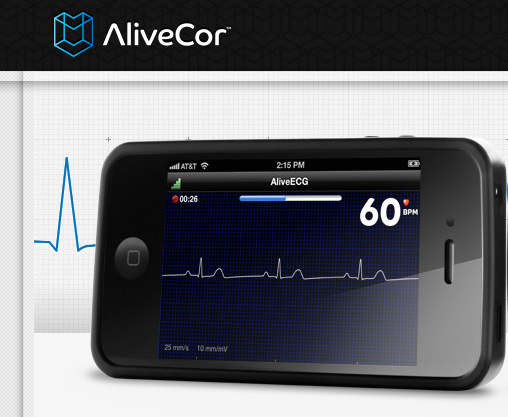
AliveCor created its mobile electrocardiogram (ECG) recorder, which is basically an iPhone case embedded with electro sensors.

It lets anyone perform a routine heart checkup by pressing a smartphone to their chest.

This means patients could share weekly, or even daily, readings with doctors.


In this 15-part series on the thrilling, disruptive potential of "mHealth," I highlight businesses using mobile technology in health care.

Leveraging the wonders of a device that's fast becoming ubiquitous – two in three people worldwide own a cell phone – a new generation of startups is building apps and add-ons that make your handheld work like high-end medical equipment.

Cheaper, sleeker, and a lot more versatile.

Tuesday, November 27, 2012

2 of 15 startups building apps for healthcare


Take your blood pressure!

Once users plug the Withings Blood-Pressure Monitor into an iPhone, iPad, or iPod touch, they can see their data displayed in graph form.

Then, you can send them to doctors, and more. 

Watch a demo video at withings.com

In this 15-part series on the thrilling, disruptive potential of "mHealth," I highlight businesses using mobile technology in health care.

Leveraging the wonders of a device that's fast becoming ubiquitous – two in three people worldwide own a cell phone – a new generation of startups is building apps and add-ons that make your handheld work like high-end medical equipment.

Cheaper, sleeker, and a lot more versatile.


Monday, November 26, 2012

1 of 15 startups building apps for healthcare

Examine your ears!

CellScope has developed a magnifying attachment turns any smartphone camera into a mini-microscope

This allows users to capture high resolution images of their outer and middle ears, and email them to doctors for assessment.   

Future versions could include software that recommends triage treatment.

Learn more at cellscope.com 

-->
In this 15-part series on the thrilling, disruptive potential of "mHealth," I highlight businesses using mobile technology in health care.

Leveraging the wonders of a device that's fast becoming ubiquitous – two in three people worldwide own a cell phone – a new generation of startups is building apps and add-ons that make your handheld work like high-end medical equipment.

Cheaper, sleeker, and a lot more versatile.

Saturday, November 10, 2012

6 ideas to more accurately reflect today's modern family


“Today's modern family is more than a hit TV show,” writes Rob Rosenberg is president of  Springboard Brand and Creative Strategy.  “It's a new composition of your customer groups, and you have an opportunity to make a greater impact with your marketing and creative strategies.”

In his latest blog post, Rob offers 6 ideas to more accurately reflect customers in your messaging – to reach out in more genuine and authentic ways.
  1. Re-examine your marketplace
  2. Align your customer service strategies
  3. Evaluate research methodologies
  4. Push your service-line strategies 
  5. Reflect the marketplace in your creative
  6. Continue to explore new media channels and networks 


Friday, December 23, 2011

40% readmission for CHF: the challenge and a novel innovation

“Sometimes a simple idea floods the room with light,” wrote Ross Weaver in a note to me recently.  

Ross Weaver, PharmD, MBA joined Adjility Consulting earlier this year.  In this blog, I want to share his innovation inspiration.


Here is the challenge:

Nationally, about 40% of hospitalized congestive heart failure patients were readmitted to a hospital within 120 days.

This was an interesting and medically relevant finding, but it had no negative financial implications to hospitals.  Actually, hospitals profited from readmissions because it meant more beds were filled.

However, the PPACA legislation changes all of that.  Now, the legislation allows CMS to withhold a portion of the total Medicare payments to hospitals with excessive CHF re-admissions within 30 days.

Now, there’s a financial incentive to avoid hospital readmissions!

Lots and lots of programs are being instituted to decrease the 30-day readmission rate.  Complicated approaches.  “We know best” approaches.  Intrusive approaches.  Approaches that seem good on paper, but are doomed to failure – because people are people. 

Here’s a novel idea:

Instead of reengineering the whole cardiology department, how about providing a simple IT-based solution?  How about have patients weigh themselves every day and while on the scale answer a few simple questions?  Here is the neat part.  How about have the scales submit the data daily to the appropriate medical practice, with software that identifies outliers who might need medical intervention? 

Well, that is what the Montefiore hospital is doing.  Kris Becker, RN and clinical care manager, monitors 120 heart failure patients daily.   She works with cardiologists to modify drug therapy when required, gets transportation for a patient to go to a physician’s office, and refers acutely ill patients to the emergency department.

This approach, using ‘telescales’, helps keeps small issues small.

At Adjility, we too focus on keeping small issues small.  Give us a try.

You can find contact information for Ross at adjilityhealth.com


Monday, June 15, 2009

11:15am Obama live from Chicago today -- ReachMD XM160 to broadcast President's major health care speech to physicians

I thought you all would want to know that ReachMD is going to be broadcasting President Obama's health care speech LIVE today.

The speech to America's physicians starts at 11:15am CT.

XM subscribers are invited to tune in to the President's address on ReachMD XM160.

If you are not a subscriber to XM, you can listen to the ReachMD broadcast of the President's speech online at www.reachmd.com

ReachMD is covering this event live from the convention floor at the American Medical Association annual meeting. ReachMD will also have extensive post-speech interviews and reaction by physicians and other medical professionals to the speech.

Thursday, May 07, 2009

6 Moves for Exercise while Traveling

If you’ve been keeping up with my blog, you know I’ve been traveling a lot this year — everywhere from the Philippines to Boise, Idaho, and from Tokyo to Atlanta (where we got to visit with former President Jimmy Carter. Today, I'm on my way to San Diego.

I have been fortunate for these experiences and for the relationships I have established through these meetings and conferences.

The downside of traveling can vary for many — but for me it's hard to eat healthy and get enough exercise when I'm constantly traveling. I came across an article in Hemisphere magazine with simple, but effective suggestions on how to squeeze in the exercise.

Here are some quick, easy ways to get your heart rate up:

1. Pushups
Most people know how to do a pushup, so here are some tips to maximize your results: To further target your triceps and chest, place your hands closer together. For less effort, place your knees on the floor, with ankles crossed, and lower from there.

2. Squat Jumps
With hands on hips, in a squat position, jump straight up as high as you can. Upon landing, lower back into a squat position and, in one smooth motion, jump up again.

3. Dips:
Targets the triceps. Sit on a chair with your hands on the seat and extend you legs in front of you. Straighten your arms to raise yourself and then lower yourself back down.

4. Bicep Curls
Standing with your feet shoulder-width apart, hold a small piece of luggage in front of you with palms facing up. Keep your elbows stationary and repeatedly curl the suitcase up toward your chest.

5. Arm Raises
Stand with your feet shoulder-width apart. Hold a small suitcase with your arm straight down at your side and the palm of your hand facing behind you. Raise the luggage up in front of you, keeping your arm as straight as possible. Lower and repeat.

6. Crunches
Lie on your back on the floor, with bent knees and crossed ankles. Place you feet under the bed or dresser. Place your hands across you chest or behind your head and while contracting your abs, lift your shoulder blades and upper back off the ground.

Saturday, November 08, 2008

3 alternatives to drug price controls – and how to maintain health, science and technology innovation

As the new president and a new Congress prepare to advance a new agenda, we can anticipate more attention on health care costs.

Too often, the debate focuses on drug access and price controls. But if you want cutting-edge health care, don't make it a cost-controlled commodity.

But recently Dr. Scott Gottlieb suggested 3 specific alternate avenues of pursuit. His view, published as an op-ed piece in the Wall Street Journal, is the controls are based on the premise the medical care is a commodity to be purchased at the lowest price, with little allowance for innovation. This would push new drug development over a tipping point.

Dr. Gottlieb says the most economically pernicious effect of price and access controls isn't the impact on revenue from existing drugs -- but how they distort future investment decisions. They will lower expectations that untreated diseases can continue to be re-priced, even with very effective new drugs. I work with health-care investors and companies first hand. They can reallocate capital in the face of protracted political uncertainty. They can also forego traditional discovery altogether, in favor of less socially useful but lucrative areas like lifestyle meds or prescription cosmetics. He notes that the last time policy makers waged a concerted effort to control the price of and the access to the most innovative, but expensive new drugs as part of broader health-care reform in the mid 1990s, the percent of venture capital going into biotech fell by almost half in a single year. A lot of that money shifted into Internet companies.
Of course, re-pricing diseases doesn't help people struggling to get basic health care, or those burdened by high co-pays.

So Dr. Gottlieb proposes 3 policy options to address these troubling issues – without preying on medical innovation and its health contributions.

1. Specialty drugs typically appear on the "fourth tier" of health plans, and have expensive co-pays. Drug companies need to explore alternative pricing mechanisms, including approaches that tie their reimbursement to evidence that an individual patient is benefiting.
2. Health insurers need to provide new policy holders with clear, up-front disclosures on co-pays and not stick patients with unbearable bills only after sickness strikes.
3. The FDA can also help lower overall drug spending by adopting reasonable regulatory pathways for diagnostic tests that would enable doctors to target drugs more efficiently to patients most likely to benefit.

Dr. Gottlieb also recently debated “Pharmaceutical Communication to Consumers” at the Oxford Union Society. You can read his remarks at http://www.aei.org/publications/filter.all,pubID.28737/pub_detail.asp

Friday, November 07, 2008

600 thought leaders, influencers, and global change agents from the worlds of technology, business, social innovation, science, the arts and more

Pop!Tech 2008 was plugged into change.

Pop!Tech 2008 took place October 22 – 25 in the seaside village of Camden, Maine. This year’s event charted the core scarcities humans and organizations will encounter this century – and how a wealth of new innovations, bottom-up approaches to collaboration and insights into collective wisdom might hold the keys to addressing the challenges that lie ahead.

You can view and download presentations at http://www.poptech.org/popcasts/

One of the presenters was Dr. Jay Parkinson, who was called “a doctor you can Friend” in a blog posting.


Here’s what Michelle Riggen-Ransom reported from his presentation --

Dr. Jay Parkinson is helping health care providers and their patients connect in new ways. Using a variety of new technology tools and platforms, Parkinson is flipping the idea of healthcare around, putting the power in the consumers’ hands and making healthcare more personalized.

We’ve written about Dr. Parkinson and his company Hello Health before. In today’s talk, he gave us a deeper dive into the reasons why he created his company and his innovative thinking on the future of health care.

He asked the audience: what is the fundamental reason that relationships fail? The answer of course is poor communication. This is equally true of marriages, friendships and — it turns out — health care.

Hello Health’s website says:

We love technology, the Internet, and especially our iPhones. You can talk to us like you’re talking to a friend: through emails, texts, phone calls, instant messages, or face-to-face conversations. Also, everything’s online, from making appointments to accessing your records.

Parkinson not only uses current technologies (his website, Google calendar, PayPal and iphone updates) to improve doctor/patient communication issues, but he’s also reinvented the payment model of the healthcare system, charging a $35 a month subscription fee in addition to flat rates for things like answering emails and video or IM chats. He states that 50% of office visits are unnecessary: he’d rather the patient spend less time and money by communicating about what the problem is and determining what the next steps are based on that initial (virtual) conversation.

True to 2.0 form, Parkinson’s also has both a personal website and a blog where one can read his further thoughts on how technology, politics and pop culture impact the kind of health care we’re getting.


Michelle Riggen-Ransom is a writer who focuses on social media, technology, nature, parenting and increasingly, the intersection of those topics. She is also co-founder and Communications Director for BatchBlue Software, which makes online tools for small businesses. Having lived at various times in Boston, London, Rome, Florida, Los Angeles and Seattle, Michelle currently lives in Providence, Rhode Island.

Saturday, October 18, 2008

The crusade against chronic diseases


Through our connections in the Boise office, we’ve recently got involved with a group called Active Community Wellness. Later this month, we’ll be conducting an N-of-8 session with key members to help develop a platform for the ACW group.

In benchmarking other health and wellness initiatives, I researched a program we learned about in Mumbia, India – the Help Your Body campaign. So, I wanted to share with you some highlights of its work. You can see the entire scope at http://www.helpyourbody.in

First, some background:

The world has been clamoring about the great Indian success story. The youngest entrant into the elite Trillion Dollar Economy club, India will become the youngest nation with an estimated 700 million people under the age of 35 years India in 2025. The distressing aspect however is the overall health scenario that is turning out to be the bane for this same young productive India. India is slowly and steadily acquiring the status of the global chronic disease capital.

By 2025, India will have the dubious distinction of having 70 million diabetics, 213 million hypertensives and 60 million arthritics. The cost of these including welfare losses is estimated to be Rs 15,01,200 crores by 2015. According to the WHO repot Preventing Chronic Diseases - A vital investment, 388,000,000 people will die in the next 10 years of a chronic disease. A significant proportion of this will be in India.

A combination of the “thrifty gene hypothesis” (i.e. our genetic predisposition towards obesity and diabetes) and frantic lifestyle has brought us on the brink of a healthcare catastrophe.

Effective sustainable interventions, and the knowledge to implement them, have been shown to work in many countries. If existing interventions are used together as part of a comprehensive integrated approach by the government, the private sector and the civil society, the goal of preventing chronic diseases can be achieved.

“helpyourbody” has taken up on to join hands with the government and the World Health Organization to curb the projected upward trend of chronic diseases by 2% per annum by using various communication and education mediums.


Next, here are some of its activities:

Under the aegis of “helpyourbody” - a nationwide program, they intend bridging the existing health divide by adopting a 3-pronged approach to roll out this initiative.

1. Awareness
2. Action
3. Sustain

Awareness: Together map awareness about chronic diseases
• Risk assessment & analysis of the Indian health perspective by key endorsers
• Patient Education literature with key measures
• Channels to take the crusade across 20 cities in India.
• Mass Media
• Website
• Key Opinion Leaders (KOLs)
• Patient Education Programs

Action: Detection is the key to diagnose people at high risk
• Camps to reach out to people
• Crusader doctors to detect at least 10 high-risk patients in a month for further follow-up
• Educating through small steps for a healthy lifestyle
• Better Disease Management through:
• Special consultation & tests by specialists
• Detection camps conducted at Piramal Diagnostics

Sustain: Caring to reach out for better disease management

• Building communities across the nation with doctors, hospitals, retailers and chemists
• Conducting periodic local activities/events and camps
• Involving local NGOs to partner the same


What is the expected outcome?

The cumulative social and economic impact of these measures is bound to be immense. The incidence of chronic disease will significantly decrease, thus ensuring productive human capital, reducing disparities, minimizing economic loss by 2% every year and earning the nation Rs. 67,500 crores by 2015.

Moreover, it would help reduce disparities and save close to 1 million productive human lives. It would help propel the thriving Indian economy with an all-inclusive growth.


The sponsor of “helpyourbody” is The Piramal group

The Piramal Group understands the role of democratizing healthcare in building a global economy and reducing disparities. It says, “We consider ourselves fortunate that we can serve the community by reducing the burden of disease and have many initiatives to help us do that.” Piramal Healthcare Ltd. is a leading healthcare - pharmaceutical and diagnostics - company in the country. Piramal e-Swasthya attempts to make healthcare accessible to India’s rural communities using technology through a sustainable and scaleable service model.


We can learn a lot from the knowledge, the expertise, the reach and most importantly the deep desire of “helpyourbody” to reduce the threat of chronic diseases. I hope we can share this committment through the Active Community Wellness mission.