Showing posts with label design. Show all posts

Monday, July 29, 2013

"20 Logos We Love" from Entrepreneur magazine

Thousands of logos compete for our attention every day. 

Clearly we care about logos. But what makes a great logo?  And how can you make one that not only stands out, but also cultivates a loyal following?

In a recent issue of ENTREPRENEUR magazine, designer Andrew Shea, published some great examples.

Experts note, he says, there are at least three necessary traits: 
  1. distinct from other logos (especially those of competitors), 
  2. instantly recognizable (imagine it on a neon sign in Times Square), and 
  3. legible at all sizes (from billboards to mobile devices). 

That said, there are many ineffective logos that follow these rules. What sets the great ones apart is that they help audiences connect with the organization's mission or personality in a meaningful way.

See the slide show of the 20 favorites at www.entrepreneur.com/slideshow

Monday, May 13, 2013

What is good design? Lessons we can take from home and landscape design experts

“Entire art, architecture and design movements have been built on the question, What is good design?,” writes Melanie Warner Spencer in a recent issue of the Houston Chronicle.

In our field of marketing, advertising, and digital design, we also look to learn from others – in what Ms. Spencer describes as being “built, rebuilt, imitated, deconstructed, abstracted and reconstructed.”

I thought we could draw some parallels and lessons from her interview of a few designers and architects. Here are some of their views of what’s coming next.

David Lake and Ted Flato of Lake/Flato, award-winning architecture firm: “Good design always considers the larger problem, considers the larger context. Good design needs to make the larger environment a better place. We're also healing and mending an existing environment and trying to connect it back to that. That idea can go in many different contexts. In an urban setting, we think of the entire block and how that building can be a good citizen with the buildings around it. Good design encompasses a broader design solution. Good design needs to be comprehensive. Comprehensive is also about health.”

Laura Umansky, interior designer and owner of Laura U Collection: “Good design must consider three things: intention, function and beauty. Every decision that I make for an interior is carefully considered prior to presenting it to a client or including it in their home (intention). It must also be smart, useful and have a very valid reason to exist in the space (function). Lastly, the space as a whole should have special meaning for, and elicit an emotional response from, its inhabitant (beauty).”

Liz Lambert, designer and hotelier (her projects include El Cosmico in Marfa, the Hotel San Jose and Hotel Saint Cecilia in Austin and the Hotel Havana in San Antonio): “Good design is often about knowing when to stop. It is about finding a balance between elegance and simplicity, vibrancy and calm, old and new. It's about collecting objects that reflect your life experiences and your passion more than it is about filling a room. And for me, it's usually about letting the people be the color in the room rather than the stuff.”

Julie Schaff Risman, furniture and interior designer, owner of the Inside Story Design: “Your home should tell your story. Art and artifacts from your travels, collections and artful photos turn a house into a home and prevent the model-home look. Always add an organic element to a space: plants, fresh flowers, seagrass, shells and salvaged items breathe life and warmth into a space. Edit - if in doubt, leave it out.”

I felt these designers offered some good guidance, even for projects on my desk right now: consider the intention and function of the brand, then go beyond to tell its story in the context of the customer’s larger environment.

And most of all, know when to stop.

It’s time to launch.

Saturday, February 23, 2013

Ohio State: blend of classic and modern

A few weeks ago, I spent some time driving and walking around the campus of The Ohio State University.  

It was an inspiring blend of classic architecture and modern design.


Friday, October 19, 2012

300 designers can't be wrong

Design professionals say they get their inspiration out of the office.

Where will you go today to be inspired?


Wednesday, October 17, 2012

Roto: tour of museum and exhibit design studio with Columbus IDSA

On Saturday, I joined along with the Columbus chapter of IDSA & IxDA for a tour of the facilities and creative space of ROTO, a full-service design and production firm specializing in first-hand experiences for museums and entertainment venues. 

Roto has an award-winning design team and its own in-house exhibit engineering group.  We saw some of their work that includes interactive gadgets, immersive themed environments, content-rich interpretive exhibits, and dramatic story-driven attractions.

A few of the projects we discussed were 
  • Peoria Riverfront Museum
  • Children's Museum of Jordan
  • Smithsonian Institution National Museum of American History
  • Harley-Davidson Museum
  • Hard Rock Park, Orlando
  • Jim Henson Museum
  • COSI Columbus
Thanks to Roto for hosting the behind-the-scenes tour, and to Roto designers Mike Denison and Caroline Petitti for the insights.
 
Learn more about Roto and their approach at www.roto.com 

Take a look at some photos from the afternoon at Roto:


Wednesday, June 06, 2012

Words that establish the Ripa Hotel brand: Words that matter


Earlier this year when I stayed at the Ripa Hotel in Rome, I was greeted each day with inspiring words – words that matter – all around the hotel.

Especially these words in the elevator:  Happy and Dream.

They helped set the tone for the hotel’s brand:  all the staff were friendly, courteous and helpful.  The buffet breakfasts started our morning with an ample selection of hot and cold foods, along with my cafe latte.

The Ripa is located close to the center of Trastevere.  Read more about its design and concept at ripahotel.com

I was happy with my visit.  And I dream of returning.

All this week, I’ve been blogging about words and how they matter in persuasive writing.


Friday, April 20, 2012

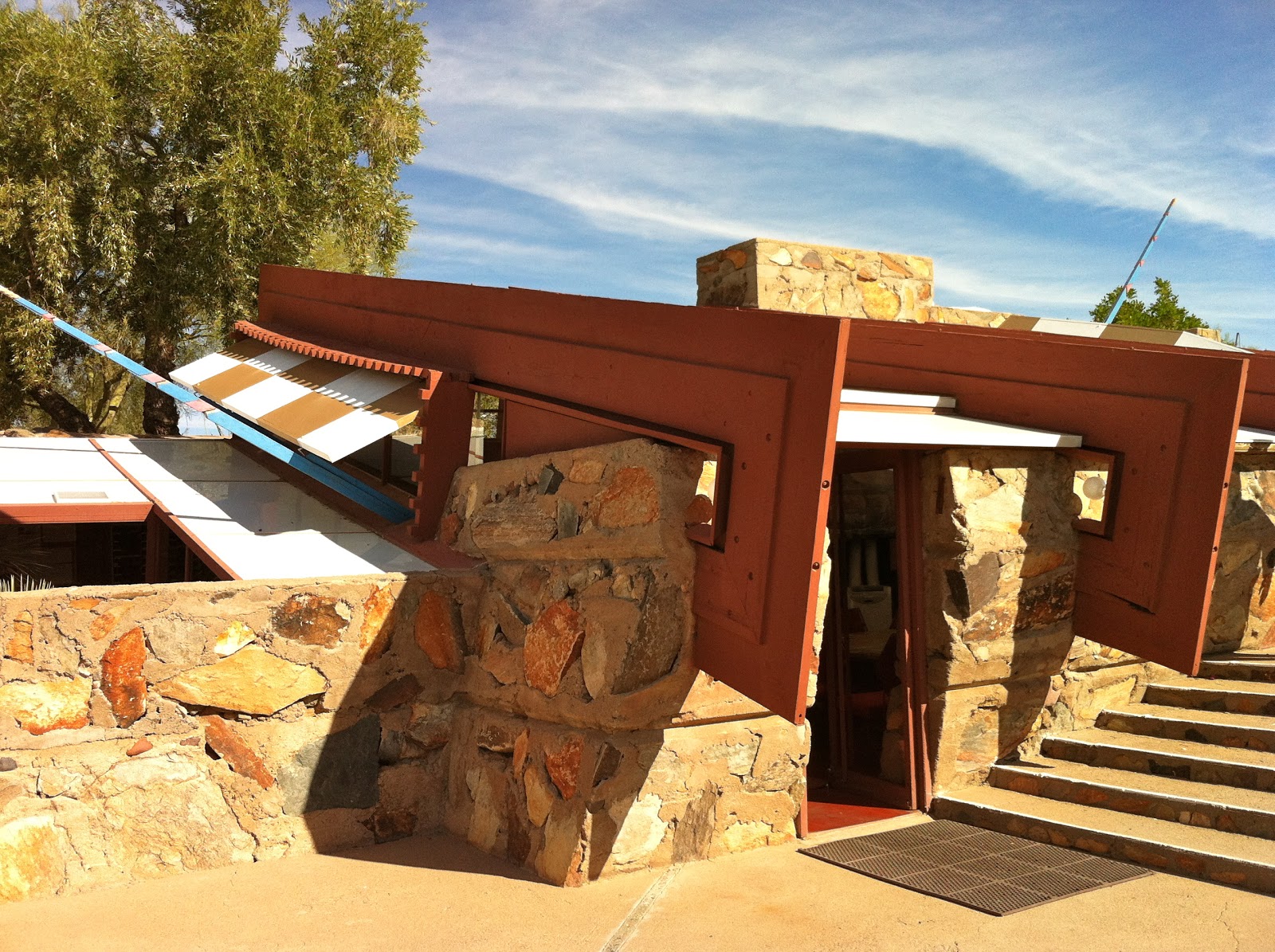
Inspiring creative spaces: Frank Lloyd Wright home, studio, and school at Taliesin West

-->
Jenny & I recently enjoyed in-depth, intimate tour of Taliesin West – the studio, home, and school of Frank Lloyd Wright located outside of Phoenix.

Our good friends Jorge & Mayte Gastelum, and son Julian joined us on this exclusive experience.

We also had the opportunity to talk with some Frank Lloyd Wright associates.  Because Mayte is an architect, this tour was especially inspiring.


We visited the living quarters and the dramatic Taliesin West living room (called the “Garden Room” by Wright).  The living room was the social gathering place for Wright and the many famous guests he entertained. As we entered through the typically Wrightian low-ceilinged, stone-walled space, it opened to a 56-feet long by 34-feet wide room, linked to the garden and bedroom wing on the east by expansive windows. We sat in Wright-designed furniture and experienced firsthand the feeling of being a guest in Wright’s famous home.

I really liked seeing Wright’s private office – connected by dramatic terraces, gardens, and walkways overlooking the rugged Sonoran Desert and Valley.  The knowledgeable guides explained how the site relates to the natural desert and provide a general overview of Wright’s basic theories of design, history of the site and activities of Taliesin Fellowship community life.

A highlight of this tour was a stop in the colorful Taliesin Fellowship dining room where we were treated to mid-morning “tea.”

Here are some more photos from our visit.


Saturday, January 07, 2012

L'Opera Garnier: a harmony of music and artchitecture

L'Opera Garnier was opened in 1875 and located on the right bank of the Seine in the 9th Arrondissement .

During my stay in Paris, my hotel was nearby and I walked past the Opera house quite often.  It occurred to me what a perfect complement of music and architecture it was.  That is true harmony of design.
 
 
With its neo-baroque , richly embellished interior style, the opera is unique among the monuments of Paris at that time, mostly by classicism and historicism. The architect wanted the opera with its own style where visitors would see and be seen. These needs in accordance with the architect created a spectacular marble staircase, the Grand Foyer , the round Salon du Glacier and finally red and gold hues.

Until the opening of the Opéra Bastille in 1989, the Palais Garnier was the largest theater in the world (even if the Vienna State Opera and La Scala in Milan have more seats). The area covers 11,237 square meters, the hall has an eight-ton crystal chandelier illuminating the staircase, and the building is constructed with over 30 different types of marble.

Outdoors, it features arch piers of the lower facade with allegorical sculptures jewelry: the lyrical poetry, the music, the idyll, declamation, singing, drama, dance and the lyric drama. Over the arc seen medallions with images of Cimarosa, Haydn, Bach and Pergolesi. In the niches of the Loggia gilded bronze busts of great composers (Halévy, Meyerbeer, Rossini, Auber, Spontini, Beethoven and Mozart) are attached. In the attic are bronze groups of lyric poetry with the Muses and the genii of Fame. The huge dome surmounted by a statue of Apollo, flanked by Pegasus figures. The side and rear facades are a relief from orbit intertwined swastikas, which is located in the upper level of the windowsills. A similar relief is also in the Sully wing of the Louvre.